


• Call us: 02 9838 0005 , 0482 677 772
  • info@smartcalibration.com.au
  • Support: 24 X 7
logo asset
  • Home
  • Who we are
  • Services & Solutions
  • Contact Us
Book A Job
logo white asset
logo white asset

Contact Info

  • 6B/163 Prospect Highway Seven Hills NSW 2147 - Australia
  • 02 9838 0005
  • 0482 677 772
  • info@smartcalibration.com.au
How to choose a quality calibration services company in Sydney with on-site and in-lab options explained

Quick Summary

• Calibration protects your business from downtime, failed audits, and costly measurement errors.

• On-site calibration service keeps operations running with minimal disruption. In-lab calibration provides the most controlled conditions for high-accuracy work.

• This guide explains how to choose a calibration services company in Sydney, what a quality calibration service looks like, and how to compare providers based on cost, turnaround, capability, and documentation.

Why Calibration Matters for Sydney Businesses

Measurement accuracy underpins everything from manufacturing and engineering to laboratory testing and field operations. If equipment drifts even slightly out of tolerance, it can cause issues that remain hidden until a batch fails, a safety check goes wrong, or an audit raises questions.

For businesses across Sydney, especially those operating under ISO, regulatory, or internal quality frameworks, calibration is a foundational requirement.

Sydney’s industries run on tight timelines and strict standards. Whether you’re working in Western Sydney’s industrial zone, medical and biotech labs, food and beverage facilities, or construction and mining operations, your tools need to perform consistently. Calibration ensures they do.

Even when an instrument seems to be working fine, small deviations can lead to:

  • product defects or recalls
  • safety incidents
  • measurement inconsistencies
  • unnecessary rework
  • unplanned downtime
  • compliance failures
  • higher operational costs

In short, calibration protects your team, your customers, and your reputation.

Compliance and accreditation expectations

Most organisations in Sydney follow processes that require traceability. When equipment is calibrated to the right standard, it becomes easier to pass audits, maintain certifications, and meet regulatory obligations.

Risks of poorly calibrated or uncalibrated equipment

Equipment rarely shows visible signs when it falls out of tolerance. That’s what makes calibration so important. Without it, your team may unknowingly make decisions based on inaccurate data.

This can lead to operational failures, failed audits, and preventable losses. Routine calibration significantly reduces these risks and keeps your processes reliable.

On-Site vs In-Lab Calibration: How to Choose the Right Approach

Sydney businesses often use both options depending on their equipment, workflows, and downtime constraints. Choosing between on-site and in-lab calibration is easier when you understand how each method works and what it’s best suited for.

What On-Site Calibration Service Means, And When to Use It

On-site calibration service is performed at your facility using portable reference standards. It’s the preferred approach when equipment is installed, heavy, or difficult to transport. It’s also ideal when stopping production or shutting down equipment isn’t practical.

On-site calibration is widely used in workshops, large manufacturing plants, warehouses, lab facilities, and medical environments across Sydney. It’s a convenient way to keep equipment running without major disruption.

Benefits of On-Site Calibration

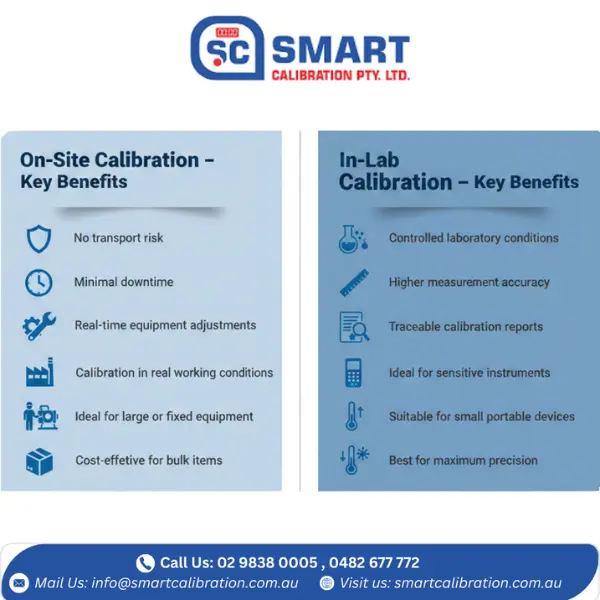
Comparison of on-site and in-lab calibration benefits for Sydney businesses
  • avoids transport risks
  • reduces downtime
  • allows immediate adjustments when possible
  • calibration happens in real operating conditions
  • efficient for large collections of tools
  • often more cost-effective for multiple items

Limitations

  • environmental conditions may influence uncertainty
  • high-precision instruments may still be better suited for in-lab calibration
  • less ideal for complex equipment requiring specialised lab setups

When In-Lab Calibration Is the Right Choice

In-lab calibration takes place in a controlled environment where humidity, temperature, vibration, and airflow are managed precisely. This is often essential for achieving the lowest measurement uncertainty.

In-lab calibration is recommended for instruments that demand the highest accuracy or require testing equipment that can’t be transported easily.

Benefits of In-Lab Calibration

  • optimal environmental stability
  • advanced testing and measurement capabilities
  • detailed traceable reporting
  • best choice for precision metrology instruments, temperature sensors, and sensitive devices

Limitations

  • requires equipment transport
  • introduces some downtime
  • dependent on courier and lab turnaround schedules

Quick Decision Flowchart

Choose On-Site Calibration If:

  • you want to minimise downtime
  • your equipment is fixed or bulky
  • you have many items to calibrate in one visit

Choose In-Lab Calibration If:

  • you need low uncertainty
  • your instruments are small and portable
  • environmental control is essential

What a Quality Calibration Services Company Should Offer

The right calibration services company should meet both technical and operational standards. Price is just one piece of the equation. Reliability, accuracy, and documentation matter just as much, often more.

Accreditation, Certification, and Traceability

A strong provider follows traceable procedures and uses reliable reference standards. Many Sydney businesses prefer calibration aligned with ISO/IEC 17025 methodology because it ensures consistency and accuracy across all instruments.

A quality provider should deliver:

  • Traceable reference standards
  • Clear procedures for each instrument type
  • Knowledgeable calibration technicians
  • Certificates with all required measurement data
  • Transparent uncertainty information

Technician Expertise and Reference Standards

Technicians should be trained and experienced in the instruments they’re calibrating. They should know how to interpret results, identify issues, and perform adjustments when allowed.

Look for providers who:

  • Maintain their own standards regularly
  • Use updated calibration equipment
  • Invest in ongoing staff training
  • Clearly explain measurement uncertainty
  • Understand industry-specific requirements

Turnaround Time and Service Level Expectations

Downtime is costly. A dependable calibration services company should provide:

  • Quick onsite availability
  • Efficient in-lab turnaround
  • Emergency or same-day service when required
  • Predictable scheduling and reminders
  • Proactive communication throughout the process

Documentation Quality

A proper calibration certificate should include:

  • As-found and as-left results
  • Reference standards used
  • Uncertainty values
  • Serial numbers and identification
  • Calibration date and next due date
  • Technician identification

Clear documentation makes audits easier and supports effective quality management.

The On-Site Calibration Process Explained Step by Step

On-site calibration process infographic showing steps from pre-booking to post-service review

Knowing what happens during an on-site visit helps your team prepare and ensures a smooth process.

1. Pre-Booking

You send the instrument list, service needs, and preferred dates. The provider confirms availability and assigns technicians based on the equipment type.

2. Arrival and Setup

Technicians arrive with calibrated reference equipment and verify that the workspace is suitable. They organise their gear efficiently to keep disruption to a minimum.

3. Pre-Checks

They inspect each instrument to ensure it’s safe, functional, and ready for calibration. If they spot potential issues, they’ll inform you before proceeding.

4. Calibration

Your instruments are compared against known standards. If adjustments are permitted, the technician will make them and recheck the results to confirm accuracy.

5. Documentation and Certificate Issuance

You receive complete calibration certificates with measurement results and traceability details. Many providers offer digital records for easier storage.

6. Post-Service Review

A good calibration services company will walk you through the results, highlight any concerns, and help plan your next calibration cycle.

Costs, Budgeting, and ROI for Calibration in Sydney

Calibration costs vary based on equipment type, accuracy requirements, and whether you choose onsite or in-lab service. Understanding the main cost drivers helps you plan your budget.

Typical Factors That Influence Cost

  • Type of instrument
  • Required accuracy and uncertainty
  • Onsite vs in-lab service
  • The number of items
  • Urgency
  • Repair needs
  • Documentation level

Common Price Considerations

On-site calibration can save money when you have multiple instruments, especially if transporting them would interrupt operations. In-lab calibration may cost less for individual items but introduces downtime and courier fees.

While price matters, choosing the cheapest option can backfire. Poor calibration quality can lead to failed audits, data inaccuracies, and time-consuming rework. Investing in a quality calibration service usually reduces long-term costs.

The ROI of Quality Calibration

Effective calibration delivers long-term value through:

  • Reduced downtime
  • Fewer product issues
  • Smoother audit outcomes
  • Lower rework costs
  • Equipment that lasts longer
  • Predictable maintenance cycles

Reliable calibration is an investment that pays for itself many times over.

Industry-Specific Considerations for Sydney Businesses

Different industries across Sydney rely on instruments that require specialised knowledge. The right calibration partner understands these needs and tailors their approach accordingly.

Manufacturing and Engineering

Common tools include torque devices, pressure gauges, dimensional instruments, and electrical test equipment. On-site calibration is convenient for production tools that can’t easily be removed.

Food and Beverage

Temperature, humidity, and weighing devices play a major role in safe and compliant production. High-accuracy probes often require in-lab calibration, while process-installed devices benefit from on-site service.

Pharmaceutical and Medical

Precision is critical. Temperature devices, pressure instruments, biomedical equipment, and sensitive lab tools need detailed reporting and reliable turnaround.

Mining and Industrial

Load cells, scales, pressure equipment, and rugged field instruments often remain installed. On-site calibration helps avoid costly shutdowns and transport challenges.

Construction and Surveying

Tools like lasers, levels, and measuring devices require regular verification. On-site calibration saves time and keeps field teams efficient.

Vendor Comparison Checklist & Template

A structured comparison helps you choose the right calibration services company in Sydney. Use the checklist below to shortlist and score your options.

Calibration Services Company Checklist

  • Accreditation or alignment with ISO/IEC 17025
  • Onsite and in-lab capability
  • Experience with your instrument types
  • Qualified technicians
  • Reliable turnaround times
  • Comprehensive certificates
  • Transparent pricing
  • Digital certificate or asset management options
  • Ability to handle recurring cycles
  • Fast Sydney response times
  • Repair capability
  • Strong reviews and industry experience

Suggested Comparison Matrix

Create a simple table with:

  • Accreditation
  • Onsite capability
  • Instrument coverage
  • Turnaround time
  • Cost
  • Certificate detail
  • Additional services

Score each column to make an objective decision.

Call to action asking if you are ready to improve measurement accuracy with a get a free quote button

Conclusion

Choosing the right calibration services company in Sydney ensures your equipment stays accurate, your audits run smoothly, and your operations stay efficient. A quality calibration service gives your business confidence in every measurement.

Use the guidance in this article to evaluate providers, decide between on-site and in-lab options, and select a partner who understands your industry’s needs.

When you’re ready to streamline your calibration program or book a reliable on-site service in Sydney, connect with a team that values accuracy, transparency, and long-term support.

FAQs

What’s the difference between on-site and in-lab calibration?

On-site calibration happens at your facility, reducing downtime and transport risk. In-lab calibration takes place in a controlled environment and is ideal for instruments that need the highest precision.

How often should instruments be calibrated?

Most businesses follow a 6- or 12-month schedule, but some equipment may need more frequent checks depending on usage, criticality, and drift behaviour.

What should I expect during an on-site calibration visit?

Technicians will set up their equipment, check environmental conditions, calibrate your instruments, adjust when allowed, and provide complete documentation.

Can a calibration provider manage our assets?

Many providers offer digital certificates, automated reminders, and asset tracking features to make ongoing management easier.

What happens if an instrument fails calibration?

The technician will explain the issue, recommend repairs or adjustments, and perform a follow-up calibration once the problem is resolved.

Recent Posts

How to Choose a Quality Calibration...
April 13, 2020
  • Any Questions? Call us

    0482 677 772

  • Any Questions? Email us

    info@smartcalibration.com.au

logo white asset

We are a team of highly qualified technicians and professionals with more than 20 years of experience in the field of calibration services and products.

Calibration Service

  • Electrical & Electronics Calibration
  • Temperature & Humidity
  • Pressure & Vacuum Gauge
  • Gas Monitor Calibration
  • Dimensional Calibration

Quick Links

  • About
  • Why Calibration
  • Service & Solution
  • Contact Us
  • Why Choose Us
  • ISO 9001:2015 Scope
  • Blog

Quality Standard

JAS ANZ
compass ISO 9001-2015
Popular Searches
  • Ammeters
  • Energy Meters
  • LCR Meter
  • Volt Meters
  • Frequency Meter
  • Ammonia Detectors
  • Gas Transmitters
  • Medical Freezers
  • Temperature Gauges & Controllers
  • Glass thermometers
  • Hydrothermographs
  • Medical sterilisers
  • Cold storage facilities
  • Moisture Analyzer
  • Dial Gauges
  • Gauge Blocks
  • Theodolites
  • Dumpy Levels
  • Vernier Calipers
  • Torque Meter
  • Torque Wrench
  • Force Indicator
  • Standard Masses
  • Tension Tester
  • Pinch Gauge
  • Compression Tester
  • Sound Level Meter
  • Audio Meter
  • Laser Level Calibration
  • Pipe Laser

(©) 2020 SMART Calibration. All rights reserved.

  • Privacy Policy
  • Terms & Conditions

Book A Job


Instruments and Calibrataion